
Reishi (Ganoderma lucidum) – Scientific Overview, Bioactive Compounds, Benefits & Clinical Evidence
By myXilluim Team1/1/202612 min read
## Abstract
Reishi (*Ganoderma lucidum* sensu lato), also known as Lingzhi (靈芝) in Chinese and Reishi/Mannentake in Japanese, is a polypore mushroom with over 2,000 years of documented use in East Asian medicine for promoting health, longevity, and resilience to disease. Modern research has identified multiple classes of bioactive compounds—particularly polysaccharides (β-glucans), triterpenoids (ganoderic acids), and proteins/peptidoglycans—associated with immunomodulatory, anti-inflammatory, antioxidant, and potential anticancer effects.
Human clinical trials suggest that standardized Reishi preparations may have modest benefits as adjunct therapy in cancer care (immune modulation, quality of life), immune support in specific contexts, and possible metabolic effects; however, evidence is still limited, often small in size, heterogeneous in preparations, and not sufficient to support use as a stand-alone treatment for serious diseases.
Overall, Reishi appears generally well tolerated for short- to medium-term use, but mild gastrointestinal and dermatologic side effects occur, and there are important cautions for people on anticoagulants, antihypertensives, antidiabetic drugs, or with liver disease, pregnancy, or autoimmune conditions.
*Note: This article is informational only and does not replace medical advice. Always consult a qualified healthcare professional before using Reishi for any medical condition.*
---
### 1. Taxonomy, Identity & Nomenclature
* **Genus:** *Ganoderma*
* **Traditional species name:** *Ganoderma lucidum* (Curtis) P. Karst.
* **Common names:** Reishi, Lingzhi (靈芝), Mannentake (“10,000-year mushroom”).
Historically, the name *Ganoderma lucidum* was used broadly, but modern mycology shows that many “Reishi” products may come from closely related species such as *G. lingzhi*, *G. sichuanense*, and others. This taxonomic complexity is important because phytochemical profiles and potency may differ between species and cultivation conditions.
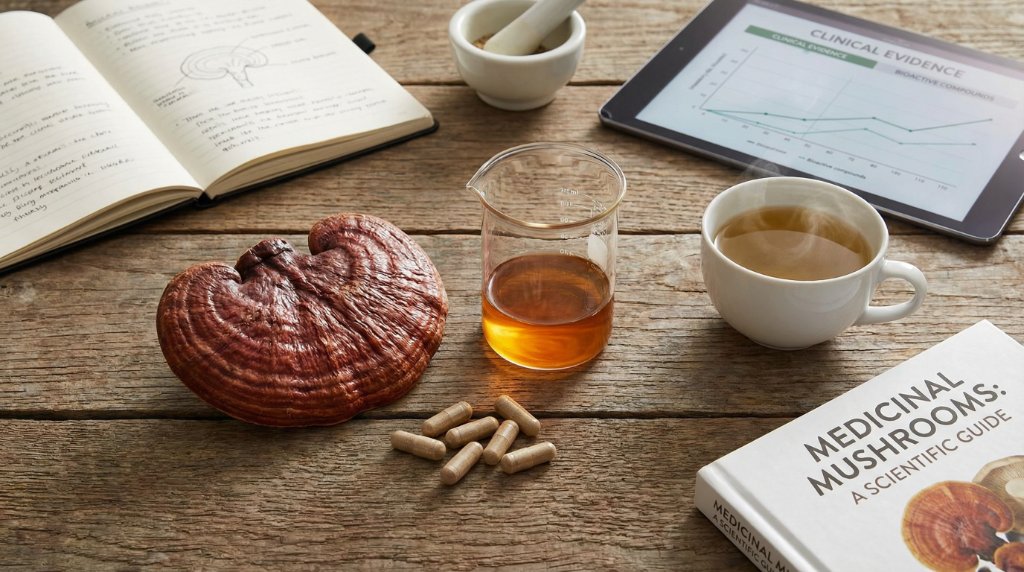
The mushroom is a woody, fan-shaped polypore with a varnished, reddish-brown cap and a white to yellow pore surface. It is too tough to be eaten as food; traditional use is mostly as decoctions (tea), powders, or extracts.
### 2. Historical & Traditional Clinical Use
#### 2.1 Traditional Chinese Medicine (TCM)
In TCM, Lingzhi has been documented for over two millennia. Classical materia medica texts describe it as:
* A “superior” (tonic) herb used long-term to promote health and longevity.
* Acting primarily on the Heart, Lung, Liver and Kidney meridians.
* Indications traditionally included:
* Fatigue, weakness, “Qi and blood deficiency”
* Chronic cough, asthma or shortness of breath
* “Calming the spirit” – insomnia, anxiety, palpitations
* Supporting recovery from chronic illness and old age
It was historically reserved for the elite due to rarity in the wild.
#### 2.2 Japanese Kampo & East Asian Integrative Medicine
In Japanese Kampo practice, Reishi (Mannentake) has been used as a tonic for chronic disease, neurasthenia, and liver support, and in combination formulas for cardiovascular and metabolic conditions.
In modern East Asia (China, Japan, Korea, Taiwan), Reishi products are widely used as health foods or “functional foods”, especially among patients with cancer, chronic hepatitis, and metabolic diseases, generally as an adjunct to conventional therapy.
### 3. Bioactive Compounds
Reishi’s pharmacological effects are mainly attributed to:
1. **Polysaccharides (especially β-1,3/1,6-glucans)**
* Large, branched polysaccharides and proteoglycans from the fruiting body and mycelium.
* Demonstrated immunomodulatory, anti-tumor, anti-inflammatory and antioxidant activities in vitro and in vivo.
2. **Triterpenoids (Ganoderic acids & related compounds)**
* Lanostane-type triterpenes (ganoderic acids, lucidic acids, ganoderiols).
* Show anti-inflammatory, hepatoprotective, anti-proliferative, and anti-angiogenic effects in experimental models.
3. **Proteins, peptides & peptidoglycans**
* Lectins, fungal immunomodulatory proteins (FIPs) and peptidoglycans that interact with immune cells.
4. **Phenolic compounds & other small molecules**
* Contribute antioxidant capacity and may modulate signaling pathways such as NF-κB, MAPK, PI3K/Akt.
These constituents vary by species, strain, part used (fruiting body vs spores vs mycelium), extraction method (water vs ethanol), and cultivation conditions, which complicates comparison between studies.
### 4. Mechanisms of Action (Experimental Evidence)
#### 4.1 Immunomodulation
Reishi polysaccharides and β-glucans:
* Activate innate immune cells: macrophages, dendritic cells, natural killer (NK) cells.
* Modulate adaptive immunity: influence T-helper 1/Th2 balance, increase certain cytokines (e.g., IL-2, IFN-γ) and antibody responses.
* Act via pattern-recognition receptors such as Dectin-1, TLR2/4, and downstream NF-κB and MAPK pathways.
This leads to context-dependent immune modulation—sometimes boosting cell-mediated immunity, sometimes dampening excessive inflammation.
#### 4.2 Anti-cancer & Cytoprotective Effects
In vitro and animal studies show that Reishi extracts and isolated polysaccharides/triterpenes can:
* Induce apoptosis and cell cycle arrest in various cancer cell lines.
* Inhibit angiogenesis and metastasis-related pathways.
* Reduce oxidative stress and DNA damage.
* Enhance the immune system’s anti-tumor response.
These findings have inspired clinical research using Reishi as a complementary agent in oncology (see Section 5.1).
#### 4.3 Metabolic & Cardiovascular Effects
Experimental models suggest that Reishi components may:
* Improve insulin sensitivity and glycemic control.
* Modulate gut microbiota relevant to metabolic regulation.
* Lower blood lipids and blood pressure in animal models.
Human data are less impressive and sometimes negative (Section 5.3).
#### 4.4 Hepatoprotective & Antioxidant Effects
Several preclinical studies indicate hepatoprotective effects against chemical toxins and oxidative stress, thought to be mediated by triterpenes and polysaccharides via antioxidant and anti-inflammatory mechanisms.
### 5. Human Clinical Evidence
#### 5.1 Cancer & Supportive Care
**Systematic reviews:**
A Cochrane review (2016) of Reishi for cancer included randomized controlled trials (RCTs) where Reishi was used along with chemotherapy/radiotherapy. Findings:
* Some trials showed improved immune parameters (e.g., NK cell activity, CD4/CD8 ratios) and modest improvements in response rates when combined with conventional treatment.
* No strong evidence that Reishi alone shrinks tumors or improves overall survival.
* Study quality was generally low: small sample sizes, heterogenous products and endpoints.
**Conclusion:**
Reishi may be useful as an adjunct to standard oncology treatments to modulate immunity and possibly improve quality of life, but it should not be used as a substitute for evidence-based cancer therapy.
#### 5.2 Immune Modulation in Non-cancer Populations
A 2023 controlled trial found that Reishi β-glucan supplementation in healthy adults modulated immune responses (e.g., NK cell function) without significant adverse effects or changes in liver or kidney markers.
Earlier trials in children consuming yogurt enriched with Reishi β-glucans also showed increased immune cell counts, suggesting a potential role in general immune support, though clinical outcomes (e.g., infection rates) require further study.
#### 5.3 Metabolic Syndrome & Type 2 Diabetes
A double-blind, randomized, placebo-controlled trial in adults with type 2 diabetes and metabolic syndrome (84 participants) compared Reishi, Reishi + Cordyceps, and placebo over 16 weeks:
* No significant improvement in HbA1c, fasting glucose, blood pressure, or lipids compared to placebo.
The Cochrane review on cardiovascular risk factors similarly concluded that evidence does not support Reishi as an effective treatment for metabolic or cardiovascular endpoints.
More recent small trials continue to explore Reishi’s metabolic impact, but data remain inconsistent and not strong enough to recommend it as a primary therapy for diabetes or metabolic syndrome.
#### 5.4 Fatigue, Quality of Life & Mood
Some smaller studies in patients with cancer-related fatigue, chronic fatigue syndromes, or fibromyalgia report reductions in fatigue and improvements in quality-of-life scores with Reishi supplementation compared to placebo. However, these trials are typically small and heterogeneous.
#### 5.5 Liver Disease
Reishi is frequently used in East Asia by patients with chronic hepatitis or fatty liver, but high-quality human trials are limited. Most evidence is preclinical or uncontrolled. At the same time, rare case reports and pharmacovigilance data suggest possible idiosyncratic liver injury, although large-scale data (e.g., LiverTox) indicate that clinically apparent hepatotoxicity is very rare relative to widespread use.
### 6. Safety, Adverse Effects & Drug Interactions
#### 6.1 General Tolerability
Short-term use (up to ~16 weeks) of powdered Reishi or extracts is generally considered possibly safe in adults at typical supplemental doses. Reported mild side effects include:
* Dry mouth, throat or nose
* Gastrointestinal upset (nausea, diarrhea, constipation)
* Skin itching or rash
* Headache, dizziness, insomnia
A 2024 toxicology assessment of organic Reishi powder in animal models found no significant acute or subchronic toxicity and no genotoxicity at high doses, supporting a relatively favorable safety profile when properly produced.
#### 6.2 Liver Toxicity
Case reports exist of Reishi-associated liver injury, but large reviews (e.g., LiverTox) emphasize that given the very widespread global use, clinically significant liver injury appears extremely rare.
Risk may be higher with high-dose concentrated extracts, contaminated products, or prolonged use, though definitive causal data are limited.
#### 6.3 Bleeding Risk & Cardiovascular Effects
Reishi may:
* Increase bleeding tendency, especially when combined with:
* Anticoagulants (warfarin, DOACs)
* Antiplatelet drugs (aspirin, clopidogrel)
* High-dose omega-3s or other agents affecting coagulation
* Potentially lower blood pressure; when combined with antihypertensive drugs, additive hypotension is theoretically possible.
#### 6.4 Blood Glucose & Immunity
Because of possible hypoglycemic effects, Reishi might potentiate antidiabetic drugs, increasing the risk of low blood sugar in some individuals.
As an immunomodulator, it should be used cautiously by people on immunosuppressive medications (e.g., post-transplant) or with autoimmune diseases, as effects are not fully predictable.
#### 6.5 Special Populations
* **Pregnancy & lactation:** Insufficient reliable data; most authorities advise avoiding Reishi in these groups.
* **Children:** Limited data; some controlled use in trials (e.g., β-glucan-enriched foods), but routine supplementation should be supervised by qualified professionals.
### 7. Preparations, Standardization & Dosing
#### 7.1 Common Forms
* Dried fruiting body slices (for decoction/tea)
* Powdered fruiting body
* Hot water extracts (polysaccharide-rich)
* Ethanolic or dual extracts (triterpenoid + polysaccharide)
* Spore powder or “broken spores” products
Standardization is often to polysaccharide (%), triterpene (%), or both. Unfortunately, studies show that many commercial Reishi supplements have high variability and may not match their label claims, so using products from reputable, third-party-tested manufacturers is critical.
#### 7.2 Typical Doses Used in Studies
Human clinical trials have used a wide range of doses, for example:
* **Dried mushroom equivalent:** often 1–9 g/day, sometimes higher.
* **Extracts:** commonly equivalent to 500–3,000 mg/day of extract (standardized to specific polysaccharide/triterpene content), taken for 4–24 weeks.
Because of the heterogeneity of preparations, no single dosing standard can be recommended for all purposes. Dosing for specific clinical indications should be guided by a healthcare professional familiar with both evidence and product quality.
### 8. Evidence-Based Summary of Benefits
Based on current scientific and clinical data:
* **Immune modulation (general):**
* Good experimental support and some human data showing changes in immune markers.
* Possible role as a supportive immune tonic, but clear clinical outcomes (infection reduction, etc.) need more robust trials.
* **Adjunct in cancer care:**
* Systematic reviews support potential benefits as an adjunct to chemotherapy/radiotherapy, improving some immune indices and possibly tumor response, but evidence is not strong enough to use Reishi as primary therapy.
* **Fatigue, quality of life, mood:**
* Some positive small trials, particularly in cancer-related fatigue and chronic fatigue syndromes, but sample sizes are small and methods vary.
* **Metabolic health, diabetes, cardiovascular risk:**
* RCTs to date are largely negative or inconclusive for hard endpoints such as HbA1c, blood pressure, and lipids, so Reishi should not be relied upon as a primary treatment for these conditions.
* **Liver health:**
* Promising preclinical data; very limited controlled human evidence. Use cautiously, especially in those with existing liver disease or on hepatotoxic drugs, given rare but reported liver injury.
* **Safety:**
* Generally well tolerated for short- to medium-term use at moderate doses, but mild side effects are relatively common and important drug interactions are plausible.
### 9. Limitations of Current Research & Future Directions
**Key limitations:**
* **Heterogeneous products:** Different species, extraction methods, and standardizations make comparison between trials difficult.
* **Small and short trials:** Many RCTs use small sample sizes and short durations.
* **Lack of hard endpoints:** Many studies focus on surrogate markers (immune cells, cytokines) rather than clinically meaningful outcomes (infection rates, survival, hospitalization).
* **Potential publication bias:** Positive studies may be overrepresented in the literature.
**Future research priorities include:**
* Large, well-designed RCTs using rigorously standardized products.
* Mechanistic studies linking specific Reishi constituents to human clinical effects.
* Long-term safety and interaction studies in real-world patient populations (e.g., oncology, diabetes).
* Clarifying species-specific differences within the *Ganoderma* complex.
### 10. Practical Takeaways
If we condense the science into a practical view:
1. **Reishi is one of the best-studied medicinal mushrooms,** with strong traditional use and growing modern research.
2. **The strongest evidence is for immune modulation and adjunctive use in cancer care,** not for curing diseases by itself.
3. **Claims about dramatic effects on blood sugar, blood pressure, or liver disease** are not strongly supported by current human data.
4. **Quality of the product and appropriate dosing are critical,** and Reishi should always be considered a complementary, not replacement, therapy, used under professional guidance when there is an underlying medical condition.